Informes de eventos
C.IAS Lecture Series
Winter Semester 2025/26
November 5
Carolyn Defrin: “By Sea and by Land: Mapping European and American Borderscapes Through Art”
Carolyn Defrin from the University of Graz gave a talk titled “By Sea and by Land: Mapping European and American Borderscapes through Art.” Defrin shared early research findings on art in the context of borders, based on a recent research trip along the US/Mexico border, during which she visited museums and community arts initiatives. She compared these findings on how art responds to borders with a current project based in Samos, Greece, and Tenerife, Spain, exploring how art can shape social relationships between key border actors. As part of the lecture, students participated in interactive arts methods to explore how creative mapping of temporalities could lead to future imaginings of migration and borders.
November 12
Julia Roth: “Becoming Ruthless: Toward a Cultural Reading of Law”
Julia Roth from the Center for Inter-American Studies at the University of Bielefeld shared her research on legal imaginaries as reflected in literary and cultural works, highlighting their role in fostering a critical analysis of law and justice. In her talk, she provided insights into the relationships and overlaps between society and law. Roth also discussed current political discourses and questions of justice and (human) rights, particularly in the contexts of migration, gender, reproduction, and queerness. The discussion following the talk focused on the performative aspects of justice, as well as the cultural (re)productions and representations of legal discourse in social media.
December 9
Yasemin Besen-Cassino: “Serving up Politics: Effects of Political Polarization on Service Sector Workers in the United States”
The Americas cluster HuK Forum lecture was delivered by Yasemin Besen-Cassino (Montclair State University) on Effects of Political Polarization on Service Sector Workers in the United States on December 9. The lecture focused on political polarization in the United States of America as it has unfolded in retail and service sector workplaces. The talk reported on how service sector workers have experienced harassment and violence in connection with politicized issues that intensified during election years. The cases discussed centered on four main topics: Pride Month displays, narratives and symbols related to the Black Lives Matter movement, attitudes toward people experiencing homelessness, and disputes surrounding public health rules during the COVID-19 pandemic.


GITS Kickoff Event and Lecture
Ruth Wodak: "'Driving on the Right': Analyzing Far-right Rhetoric"
Since March 2025, the Center for Inter-American Studies (C.IAS) and the Centre for South East European Studies (CSEES) have become part of an umbrella institution called the Graz School of Interdisciplinary Transnational Studies (GITS). The official launch of GITS was held on December 1 at the University of Graz and was attended by staff members, colleagues, and students of the university.
The launch was followed by the lecture “Driving on the Right: Analyzing Far-Right Rhetoric” by Ruth Wodak. In the lecture, Wodak spoke on how far-right actors had shifted previously taboo language into mainstream politics and described discursive strategies such as provocation, denial, victim–perpetrator reversal, and the framing of migrants as security and welfare threats. She also addressed the emergence of a “new normal” in public discourse after the COVID-19 pandemic. The lecture was followed by student questions which addressed gender representation and the role of gender in far-right movements. The event concluded with a reception hosted by GITS for all participants.


C.IAS Spotlight Talk
The Center for Inter-American Studies launched the C.IAS Spotlight Talks, a new series of monthly lectures aimed at shedding light on pressing sociocultural topics in the Americas. For the first round of the series, we invited Anita Krainer and Johannes Waldmüller, who delivered a joint lecture titled “Inter-Culturality under Threat: An Analysis of Repression and the Constitutional Reform in Ecuador.” The lecture explored interculturality as a key principle of coexistence rooted in Indigenous relational territoriality. The speakers examined Ecuador’s current political situation and reflected on the country’s sociopolitical trajectory, focusing on state responses in relation to intercultural governance, rights, and policy development. They traced the origins of Ecuadorian interculturality back to the streets and the demands of Indigenous and popular movements of the 1990s, highlighting the grassroots activism that shaped the country’s legal and social landscape. The lecture also addressed contemporary developments, noting that planned constitutional reforms and the current sociopolitical climate have raised urgent questions about the future of interculturality in Ecuador.
CEEPUS Conference and Network Meeting
"Inter-American Perspectives of Environmental Entanglements: Literatures, Cultures, and Histories"
This year’s CEEPUS Week welcomed European scholars from the Inter-American Studies CEEPUS Network to explore the theme “Inter-American Perspectives of Environmental Entanglements: Literatures, Cultures, and Histories.” Researchers from Croatia, the Czech Republic, Hungary, Kosovo, North Macedonia, Serbia, Slovakia, and Slovenia presented their work on literature, culture, and history in the context of Inter-American studies.
Speakers and Presentations (in order of appearance):
Mirna Radin-Sabadoš (University of Novi Sad)
“The Expanse as a Narrative of the Anthropocene: Environmental Transformation and Political Conflict in a Universe Driven by ‘Progress’”István Pásztori-Kupán (Károli Gáspár University)
“The Landman Paradox: Is Global Energy Trade the Friend or Enemy of Global Environmental Protection?”David Livingstone (Palacky University)
“‘God Bless the Grass’: The Environmental Songs of Malvina Reynolds”Bea Tomšič Amon (Ljubljana University)
“The comic as an inclusive way of expression – The Eternaut”Milan Damjanoski (Blazhe Koneski, Ss. Cyril and Methodius University Skopje) “Romantic Roots and Transcendental Branches: Literary Origins of Environmental Consciousness”
Réka M. Cristian (University of Szeged)
“Inter-American Perspectives of Environmental Entanglements in the US of the Sixties”Jelena Šesnić (University of Zagreb)
“Images of Nature in H.D. Thoreou’s Walden (and “Walking”) and Margaret Fuller’s Summer on the Lakes”Mónika Fodor (University of Pécs)
“Environmental perception and imagination in Joy Harjo’s poetry”Alena Smiešková (Comenius University Bratislava)
“I Am Another You: Ecological Ontology and Hybrid Identity in Reyes and Cisneros”Fatmir Ramadani (AAB College)
“Evolving Representations of Racial Prejudice and Discrimination in American Literature: From Twain to Angelou”
SYMPOSIUM: Age and Gender in the Humanities and Social Sciences
dedicated to Roberta Maierhofer
On October 17, 2025 the symposium “Age and Gender in the Humanities and Social Sciences” was held in honor of Roberta Maierhofer and her scholarship in aging studies.
The celebration started with welcome remarks by Nicole Haring (Organizer, University of Graz), Florian Bieber (Director of the Graz School of Interdisciplinary Transnational Studies, University of Graz) and Sarah Zapusek (Coordination Centre for Gender Studies and Equal Opportunities, University of Graz).
Heike Hartung (University of Potsdam, Germany) and Nicole Haring (University of Graz, Austria) introduced and discussed Roberta Maierhofer’s scholarship in aging studies.
The first panel “Queering Age” was moderated by Elfi Bettinger (Free University Berlin, Germany) and featured presentations by Núria Casado-Gual (University of Lleida, Spain, online), José Armengol (University of Castilla-La Mancha, Spain), and Dovrat Harel (Bar-Ilan University, Israel, online).
After a short lunch break, the Round Table “Aging Studies: Contested Territories in Times of Crisis” was moderated by Barbara Zach (ÖAG, Austria) and featured Aagje Swinnen (Maastricht University, Netherlands, online) discussing the development of ENAS, along with panelists Ros Jennings (University of Gloucestershire, UK), Kim Sawchuk (Concordia University, Canada, online), Linn Sandberg (Södertörn University, Sweden, online), and Roberta Maierhofer.
The round table was followed by an online intervention featuring Julia Henderson (Chair of NANAS, University of Britisch Columbia, Canada), a personal account by Peg Cruikshank (University of Maine, USA), followed by Kate de Meideiros (Concordia University, Canada) and Tom Cole (UTHealth Houston, USA).
The final panel “Aging Mentorship, and the Life-Course” moderated by Marta Corezo Moreno (UNED, Spain) welcomed Hernando Gómez Prada (University of Murcia, Spain) and Steve Rabitsch (University of Oslo, Norway). Oana Hergentröther (University of Graz, Austria) closed this panel by personal stories and annecdotes with Roberta.
All photos taken at the event can be found here, the full Program below and Book of Abstracts here for download.
Welcome Remarks
Nicole Haring (Organizer, University of Graz)
Florian Bieber (Director of the Graz School of Interdisciplinary Transnational Studies)
Gender and Age: Maierhofer’s Scholarship in Aging Studies Revisited
Heike Hartung (University of Potsdam, Germany)
Nicole Haring (University of Graz, Austria)
Queering Age
Moderator: Elfi Bettinger (Free University Berlin, Germany)
Exploring the Epic of Older Women’s Lives
Núria Casado-Gual (University of Lleida, Spain)
Queer Temporalities in Contemporary Spanish Cinema and TV Series
José Armengol (University of Castilla-La Mancha, Spain)
“To love, to create, to express, to live” – A Typology of Aging Poems by Older Men
Dovrat Harel, Liat Ayalon (Bar-Ilan University, Israel)
Round Table: Aging Studies: Contested Territories in Times of Crisis
Moderator: Barbara Zach (ÖAG, Austria)
Aagje Swinnen (Maastricht University, Netherlands): Development of ENAS
Panelists: Ros Jennings (Gloucestershire University, UK), Kim Sawchuk (Concordia University, Canada), Linn Sandberg (Södertörn University, Sweden) and Roberta Maierhofer (University of Graz, Austria)
Online Interventions: North American Network of Aging Studies
Development of NANAS
Julia Henderson (Chair of NANAS, University of British Columbia, Canada)
Recollections of Roberta, a Wonderful Friend
Peg Cruikshank (University of Maine, USA)
Anocriticsm and the Performance of Masculinity in Interviews with Older Men
Kate de Medeiros (Concordia University, Canada)
Cultural Spiritual Renewal
Tom Cole (UTHealth Houston, USA)
Aging, Mentorship, and the Life-Course
Moderator: Marta Corezo Moreno (UNED, Spain)
Aging at the Margins: Older Transgender Women, Sex Work, and the Gendered Exclusion in Spain
Hernando Gómez Prada (University of Murcia, Spain)
¡Los vaqueros auténticos!: A worlding appreciation of a hemispheric icon
Steve Rabitsch (University of Oslo, Norway)
Metaphors and Sayings
Oana Hergenröther (University of Graz, Austria)


Tage des indigenen Widerstands / Days of Indigenous Resistance
The Indigenous Rights Collective Austria organized the Days of Indigenous Resistance and invited the public to explore new perspectives on the history and contemporary realities of Indigenous communities. Participants attended a diverse on-site program featuring guests closely connected to Indigenous traditions. On October 9, the Center for Inter-American Studies, one of the event sponsors, hosted participants on the second day of the Days of Indigenous Resistance. The program that day included three book presentations and four short films screening.
César A. Alcedo introduced “Takilka” as a music education method rooted in pre-Hispanic semiotics that combined music theory with foundational Andean ancestral symbols such as the Chakana and Wiphala. During the presentation, Alcedo outlined the development of the method, which built on his grandfather’s earlier work and included revisions, updates, and conceptual expansions led by Alcedo himself.
Alexander Buschenreiter presented readings from his two books on Hopi culture, including their spiritual concepts of the creation of Earth and humanity, as well as prophecies and warnings regarding environmental destruction.
Rita Eloranta gave a talk titled “Mochica: Grammatical Topics and External Relations”, offering an introduction to the extinct Mochica Language. She explained how grammar reflected the cosmovision of its former speakers and presented insights from language contact studies. She also introduced “Apeñ Muchik”, her revitalization initiative under the project name Apeñ Muchik, which aimed to support the revival of the Mochica language.
The evening concluded with a screening of short films created by the Escuela de Cine Amazónico. The films reflected on Amazonian communities’ deep connection to their land and addressed themes such as cultural heritage protection, climate justice, and ecological respect.


C.IAS Ciclo de conferencias
Durante el semestre de verano de 2025, en el marco de nuestro ciclo de conferencias C.IAS, recibimos a varios ponentes en Graz y en línea, centrados principalmente en el actual clima político estadounidense, pero incluyendo también reflexiones sobre las relaciones exteriores entre Estados Unidos y Europa.
2 de abril
Lonnie Johnson: "Conocer Estados Unidos después de 1945 - Programas ejemplares de "intercambio de personas" de Estados Unidos en la Austria de la posguerra: Fulbright y Smith-Mundt".
La conferencia se centró en la historia y evolución de los programas de intercambio estadounidenses, concretamente el Fulbright y el menos conocido Smith-Mundt, y su impacto en la Austria de posguerra. Se analizó cómo estas iniciativas surgieron tras la Segunda Guerra Mundial, durante la ocupación estadounidense de Austria (1945-1955), como herramientas de poder blando destinadas a fomentar el entendimiento mutuo y contrarrestar el persistente sentimiento antiamericano arraigado en los prejuicios históricos, culturales e ideológicos de Austria. La conferencia destacó cómo estos "intercambios de personas" -desde estudiantes y académicos hasta periodistas y músicos de jazz- no sólo introdujeron a las élites austriacas en la sociedad estadounidense, sino que también tuvieron una influencia duradera en las relaciones entre Austria y Estados Unidos.
7 de abril
Elizabeth Dillenburg: "Las hijas del Imperio: las niñas y el pasado colonial británico"
La conferencia versó sobre las historias interconectadas de la niñez, la blancura y el colonialismo británico a finales del siglo XIX y principios del XX. Destacó cómo, aunque a menudo se pasa por alto a las niñas en los estudios sobre el colonialismo, desempeñaron sin embargo un papel vital en el imperio como emigrantes, colonas, trabajadoras y creadoras de conocimientos coloniales, y fueron anunciadas como "constructoras del imperio". Para examinar las complejidades del compromiso y las experiencias de las niñas en el imperio, esta presentación analizó específicamente la Girls' Friendly Society y exploró cómo los multifacéticos programas de emigración y educación imperial de la Sociedad construyeron ideas sobre la niñez, la raza y el imperio que luego circularon globalmente. Esta presentación utilizó la Girls' Friendly Society como lente para explorar la micropolítica del colonialismo y argumentó que la comprensión del colonialismo sigue siendo incompleta sin consideraciones sobre las niñas y la feminidad.
7 de mayo
James Forsher: "La democracia en tiempos de cambio: ¿ha cambiado Donald Trump el futuro de la sociedad estadounidense?"
La conferencia analizó la historia de un siglo de los movimientos políticos de derechas en Estados Unidos y en qué medida estos movimientos presagiaron los acontecimientos políticos de hoy.
28 de mayo
Benjamin Nienass: "Duelo y transformación política"
La conferencia reflexionó sobre las conexiones del duelo y la política, concretamente sobre el papel del duelo público en el sostenimiento y la confrontación de ideologías. A partir de diferentes conceptualizaciones del duelo público, la charla consideró los registros temporales, los apegos melancólicos al pasado, así como las narrativas de "superación" y progreso.
5 de junio
Manfred Berg: "Donald Trump y la crisis de la democracia estadounidense"
La conferencia ofreció un análisis del ascenso al poder de Trump y su exitosa reelección. Discutió las posibles consecuencias para la democracia estadounidense y el reciente gobierno de Trump y su administración. Berg argumentó que el segundo mandato de Trump será una prueba de estrés para los controles y equilibrios del orden constitucional estadounidense.
SIMPOSIO: Ecocrítica y democracia
Perspectivas interamericanas
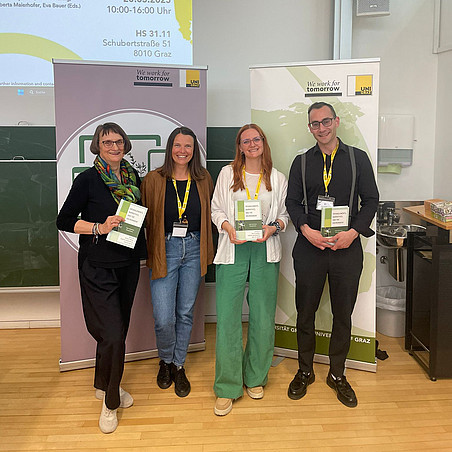
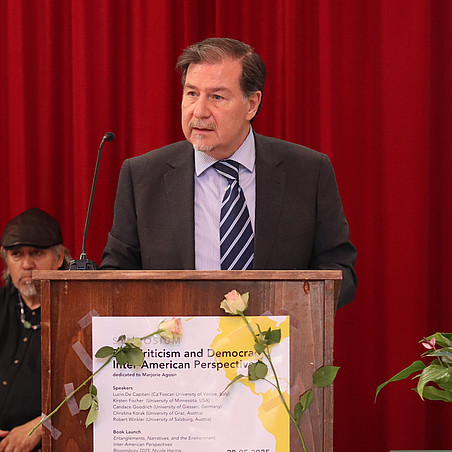
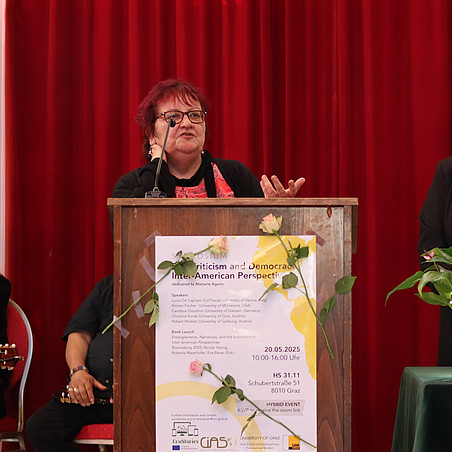
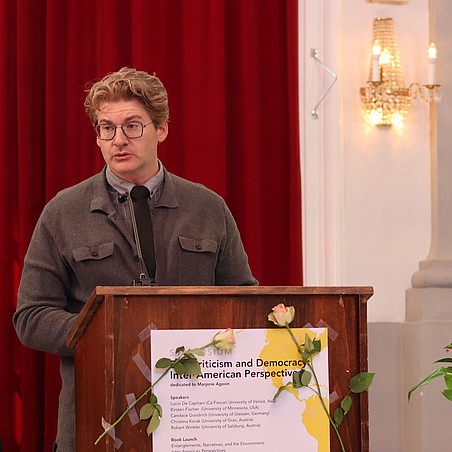
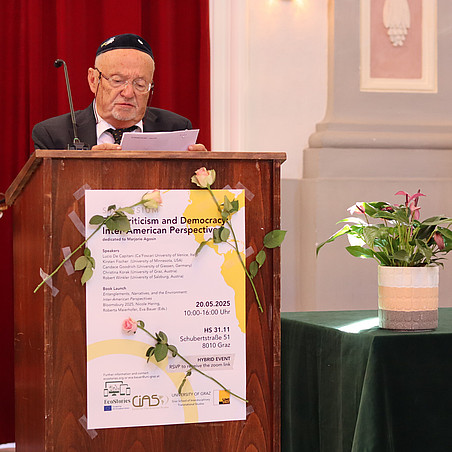
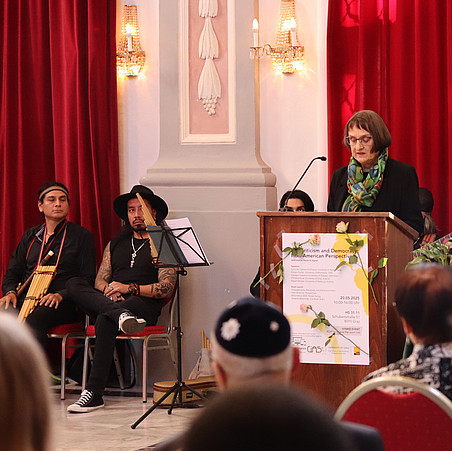
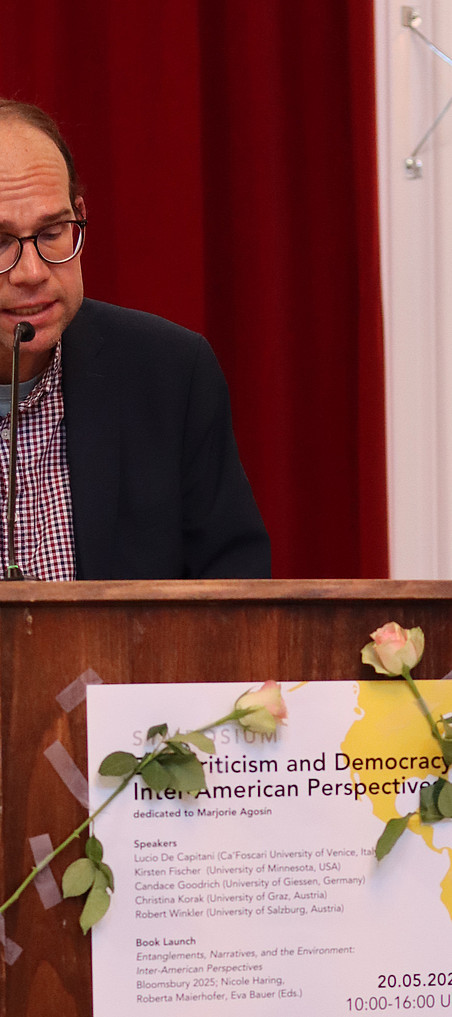
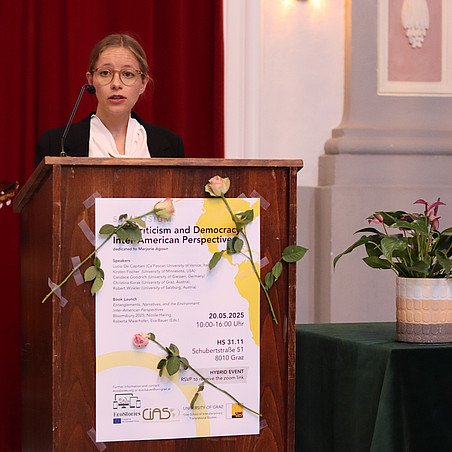
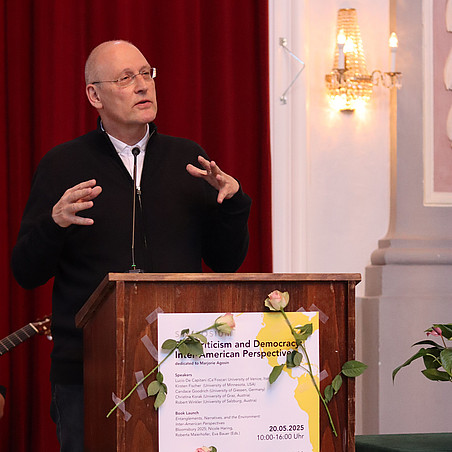
Tras la reciente publicación de nuestro volumen editado "Entanglements, Narratives, and the Environment: Inter-American Perspectives", tuvimos el placer de acoger ayer en la Universidad de Graz un simposio y la presentación de un libro titulado Eco-Criticism and Democracy: Inter-American Perspectives.
El acto reunió a especialistas de todas las Humanidades Ambientales, entre ellos Lucio De Capitani (Universidad Ca' Foscari de Venecia), Kirsten Fischer (Universidad de Minnesota), Candace Goodrich (Universidad de Giessen), Christina Korak (Universidad de Graz) y Robert Winkler (Universidad de Salzburgo). Sus ponencias ofrecieron valiosos puntos de vista sobre las intersecciones de la crisis climática, la literatura medioambiental y los enfoques democráticos desde una perspectiva interamericana.
Extendemos nuestro agradecimiento a todos los que contribuyeron a este significativo intercambio y esperamos con interés la posibilidad de una publicación de seguimiento que continúe este importante diálogo interdisciplinar.
In Memoriam Marjorie Agosín
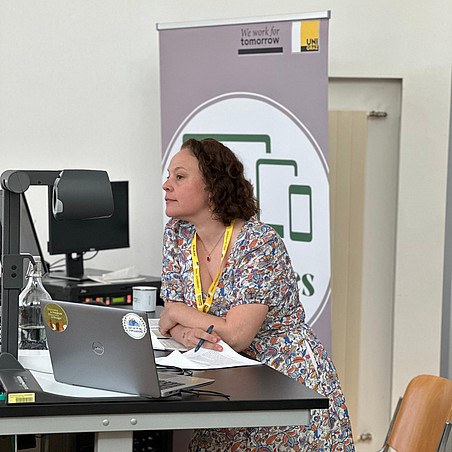
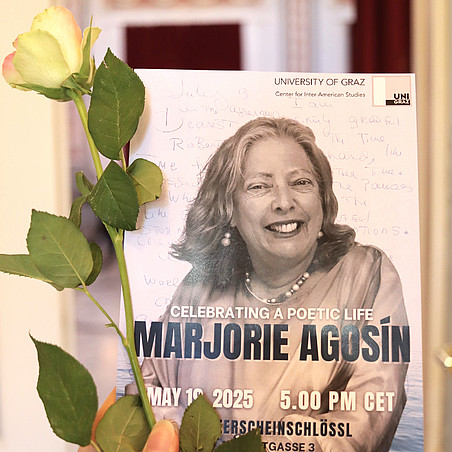
Celebrando a Marjorie Agosín, que nos dejó demasiado pronto, queremos conmemorar las huellas que dejó, reconocer las vidas que tocó y encontrar consuelo en el recuerdo que es una bendición para todos los que la quisimos y apreciamos. Marjorie se reconcilió con Austria a través del trabajo que realizó en el Centro de Estudios Interamericanos, su entusiasta participación en la Escuela Internacional de Verano de Graz Seggau, sus talleres de escritura creativa en Graz y Seggau, su tutoría a todos nosotros, y especialmente su constante amor y apoyo, siempre consciente de los retos a los que todos nos enfrentamos. Ahora, es nuestra tarea sentir este amor en nuestra pérdida, encontrar consuelo en el hecho de haber tenido el privilegio de conocer a una persona tan maravillosa, y reunirnos y en agradecimiento celebrar una vida bien vivida haciéndonos la pregunta "¿Dónde nace el amor que no acaba en dolor?". Juntos, reconociendo que "el sol cambió de color", encontraremos nuestras propias voces poéticas y "tal vez" sintamos alegría y conexión: "Pero a veces la veo aparecer en mis sueños, / Una vidente llena de amor / Que besó mi frente / Y me pide que no la olvide". Aquellos de ustedes que deseen compartir testimonios e imágenes, habilitaremos una plataforma para que puedan contribuir, que publicaremos en el sitio web del Centro de Estudios Interamericanos de la Universidad de Graz, Austria.
Grabación con zoom y fotos:
Tenga en cuenta que, debido a dificultades técnicas, los discursos de Mireille van Poppel (Universidad de Graz), Alex Weitzig (Embajador de la República de Chile en Austria), Ulrike Taberhofer (Ciudad de Graz) y Mitch Sims (Fullbright Austria) no están incluidos en esta grabación. Además, la música no fue registrada por los micrófonos que utilizamos.
Contribuciones por orden de aparición: John Wiggins, Heinz Anderwald (Comunidad Judía de Graz), Roberta Maierhofer, Kurt Hahn, Erna Pfeiffer, Nina Reibenschuh y Mirko Petric.
Música de Amaru Sunqu (Grupo Andino Latinoamericano, Perú, Chile y México)
Agradecemos a todos los colaboradores y asistentes el haber hecho posible este acto.
Para ver la grabación del acto, siga este enlace e introduzca el código de acceso: x9nC+0+7
Las fotos del acto pueden encontrarse aquí.




TRIBUNA 2025
Tres días para sumergirse en el Caribe sin salir de Graz
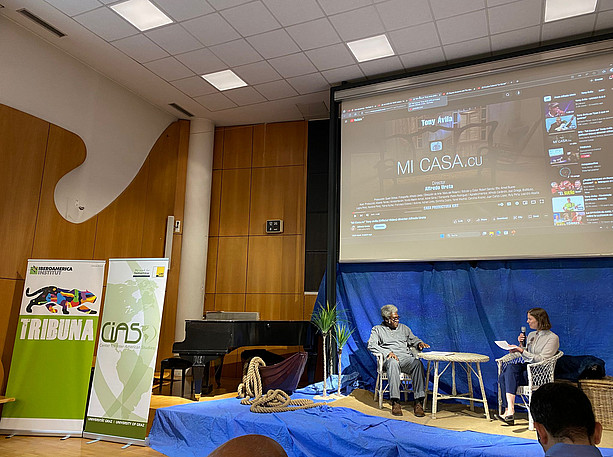
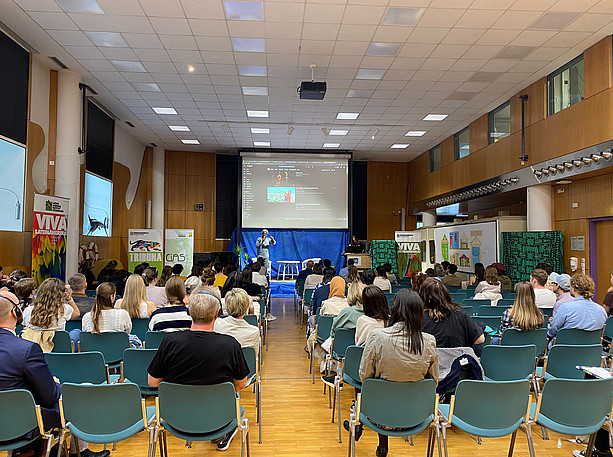
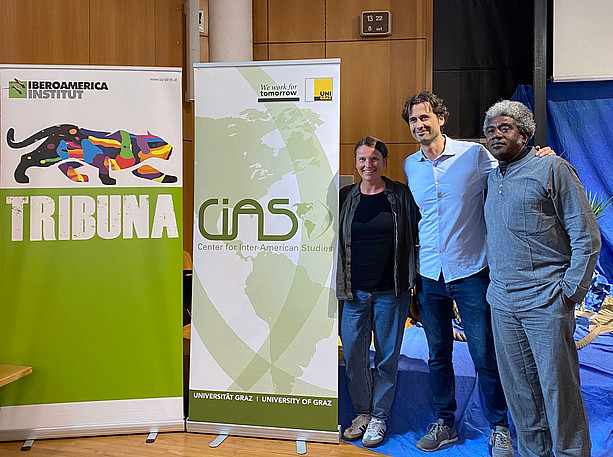
Del 14 al 16 de mayo de 2025, el Departamento Iberoamericano en cooperación con el Departamento de Estudios Románicos, el Departamento de Estudios de Traducción y el Centro de Estudios Interamericanos de la Universidad de Graz acoge el sexto festival TRIBUNA. Conciertos, charlas, talleres, teatro, exposiciones, programa infantil, degustaciones, danza y un mercado intercultural latinoamericano pusieron de relieve la cultura, la historia, la literatura, la lengua y la sociedad caribeñas.
Aquí encontrará el informe sobre el festival.