Publicaciones actuales
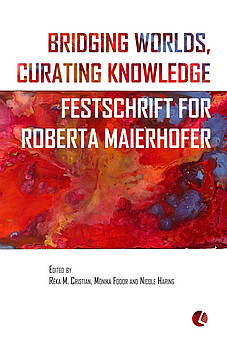
This collection of essays was compiled in honor of Roberta Maierhofer, Professor of American Studies and Director of the Center for Inter-American Studies (C.IAS) at the University of Graz, Austria, on the occasion of her retirement. As close colleagues, former students, and lifelong collaborators, we gathered our contributions in this volume around the Inter-American CEEPUS Network with its gravitational center in Graz to celebrate not only Roberta Maierhofer’s impressive intellectual contributions and extraordinary career but also the profound personal impact she has had on our academic pathways in this part of the world.
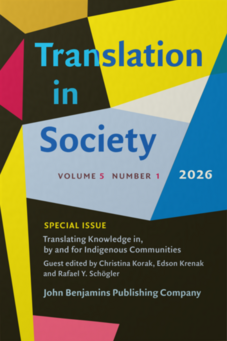
The aim of this essentially interdisciplinary journal is to explore translation as a key social relation in a deeply interconnected world.
Translation in Society produces special issues on topics of general interest in the humanities and the social sciences, seeking to foster interdisciplinary debates about how translation relates to and intervenes in the most pressing socio-political issues of our times. It is addressed to an international audience interested in social aspects of translation in the broadest sense.
Translation in Society produces special issues on topics of general interest in the humanities and the social sciences, seeking to foster interdisciplinary debates about how translation relates to and intervenes in the most pressing socio-political issues of our times. It is addressed to an international audience interested in social aspects of translation in the broadest sense.
©C.IAS Team
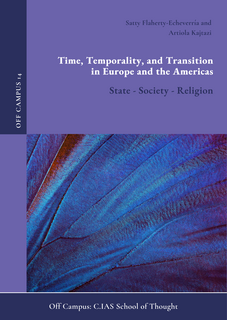
While time governs every facet of our political, economic, and social existence, its concrete impact on contemporary societal crises remains strangely underdefined. Off Campus: C.IAS School of Thought 14 bridges this critical gap, offering a vital interdisciplinary examination of how time, temporality, and transition shape states, societies, and religions across Europe and the Americas. Stemming from the rigorous academic exchanges of the GUSEGG 2025 summer school, this open-access volume moves beyond abstract ontology to analyze the collective, lived relationship between human experience and temporal structures. Spanning critical inquiries into contested chronologies, post-digital media, economic shifts, memory cultures, and the complex intersections of data, politics, age, and emotion, this collection serves as an essential roadmap for navigating the temporal forces driving our world through unprecedented change.
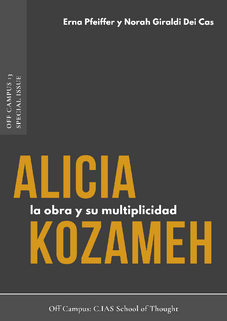
Alicia Kozameh relata en “Bosquejo de alturas” la resistencia ante el terrorismo de Estado en Argentina. La voz poética descifra sus vivencias en una lucha constante entre Eros y Thanatos, con imágenes que arrojan los centelleos de una imaginación desbordante. Su obra, en prosa y en verso, se sitúa en las cumbres de la literatura latinoamericana. Posee el arte que consiste en llegar a un horizonte abierto a la interpretación, un camino que hace resurgir de un texto a otro contenidos que van diversificándose con tonalidades minúsculas y, a la vez, poderosas, que iluminan, en particular, la oscuridad de la noche social y política que se vivió en Argentina durante un pasado que sigue presente.
En la “Segunda Conferencia Internacional sobre Derechos Humanos de Graz/Puerto Rico desde una Perspectiva Interamericana” Alicia Kozameh intervino con la lectura de parte de sus relatos y con comentarios sobre los trabajos de especialistas en su obra y de la puesta en escena de “Bosquejo de alturas”, reunidos aquí con una selección de sus cuentos y algunas de sus traducciones.
En la “Segunda Conferencia Internacional sobre Derechos Humanos de Graz/Puerto Rico desde una Perspectiva Interamericana” Alicia Kozameh intervino con la lectura de parte de sus relatos y con comentarios sobre los trabajos de especialistas en su obra y de la puesta en escena de “Bosquejo de alturas”, reunidos aquí con una selección de sus cuentos y algunas de sus traducciones.
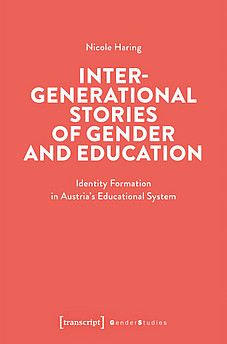
The relation between education and gender identity formation is a contested terrain: Located between reproducing society’s status-quo and inhabiting the potential to resist this reproduction and making room for alternative being, education constitutes an ambivalent nexus. Nicole Haring investigates how gender norms with their intersections are negotiated in Austria’s educational system. She presents results from a participatory intergenerational storytelling workshop as co-creation of knowledge, amplifiying the similarities and differences between generations of educators with regard to the interplay of education and gender.
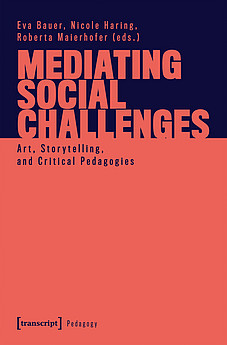
In the face of social inequalities, digital divides, hegemonic power relations, capitalist conflicts of interests, asymmetric gender relations and international border and migration regimes, educational and social actions are becoming more challenging. Mediating these social challenges demands new methods and approaches. Thus, the contributors to this volume use critical pedagogies to reflect on art, literature, storytelling, and digital methods as a means to mediating social challenges in teaching practices. The contributions challenge normative perceptions of identity while also promoting students' multiliteracy skills.
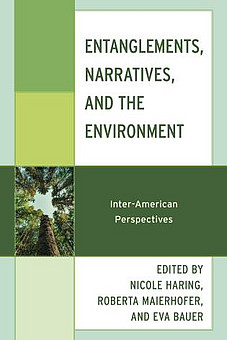
Entanglements, Narratives, and the Environment: Inter-American Perspectives provides an interdisciplinary ecocritical reading of narratives and environmental entanglements from an Inter-American perspective, predominantly providing literary, film, and cultural analysis of texts from the Americas. In light of Amitav Ghosh’s (2016) exploration of “a crisis of the imagination” in the face of climate change and environmental degradation, this book addresses the potential of literature, history, and politics in comprehending the profound dimensions and violence of these challenges. The chapters show, among others, that the Anthropocene demands fresh narratives and theoretical perspectives, particularly within the framework of Inter-American Studies, which can offer a new venue to discuss pressing issues and to provide intersectional and inter-regional considerations. Thus, drawing on Inter-American perspective with its hemispheric perspectives opens the possibilities for an ecocritical reading of the complexities and relationalities of the climate crisis in the humanities as well as the social sciences. As a result, the book includes historical and political analysis, as well as literary, cultural and film analysis of texts from the Americas. The chapters engage in deconstructing popular myths, de-centering Western approaches, and eventually show through these critical engagements how the climate crisis demands multi-dimensional readings.

Digital Storytelling and Young Adult Literature: A Methodological Combination for the Language Classroom
Digital Storytelling (DST) originated in the 1990s as a narrative technique highlighting ‘ordinary voices’ in order to contribute to the public media discourse. Soon it was picked up by education to capture the diverse lived realities of students. This paper presents a methodological development in the form of a combination of DST with extensive reading of Young Adult Literature in the English classroom. A scaffolded methodological approach is outlined where DST is used as a post‑reading activity which can be enhanced in any foreign language classroom.
Digital Storytelling (DST) originated in the 1990s as a narrative technique highlighting ‘ordinary voices’ in order to contribute to the public media discourse. Soon it was picked up by education to capture the diverse lived realities of students. This paper presents a methodological development in the form of a combination of DST with extensive reading of Young Adult Literature in the English classroom. A scaffolded methodological approach is outlined where DST is used as a post‑reading activity which can be enhanced in any foreign language classroom.
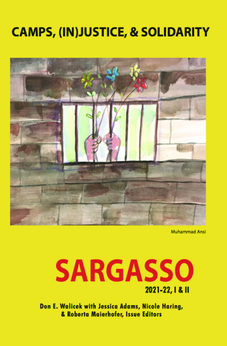
This volume of the Caribbean Studies journal Sargasso includes various papers from the 2022 Camps Conference, which was co-sponsored by the University of Puerto Rico, Río Piedras Campus and the University of Graz. In addition, it includes poetry, testimonies by former Guantánamo detainees, and a section of reviews.